Redesigning the moderation tool to increase safety
Redesigning the moderation tool to increase safety
Redesigning the moderation tool to increase safety
Project:
Redesigning the moderation tool to increase safety
COMPANY:
Dailymotion
ROLE:
Product designer
SCOPE:
Internal tools, Product design, design system lead
TEAM:
Developers, Project manager
Timeline:
2 months
Problem
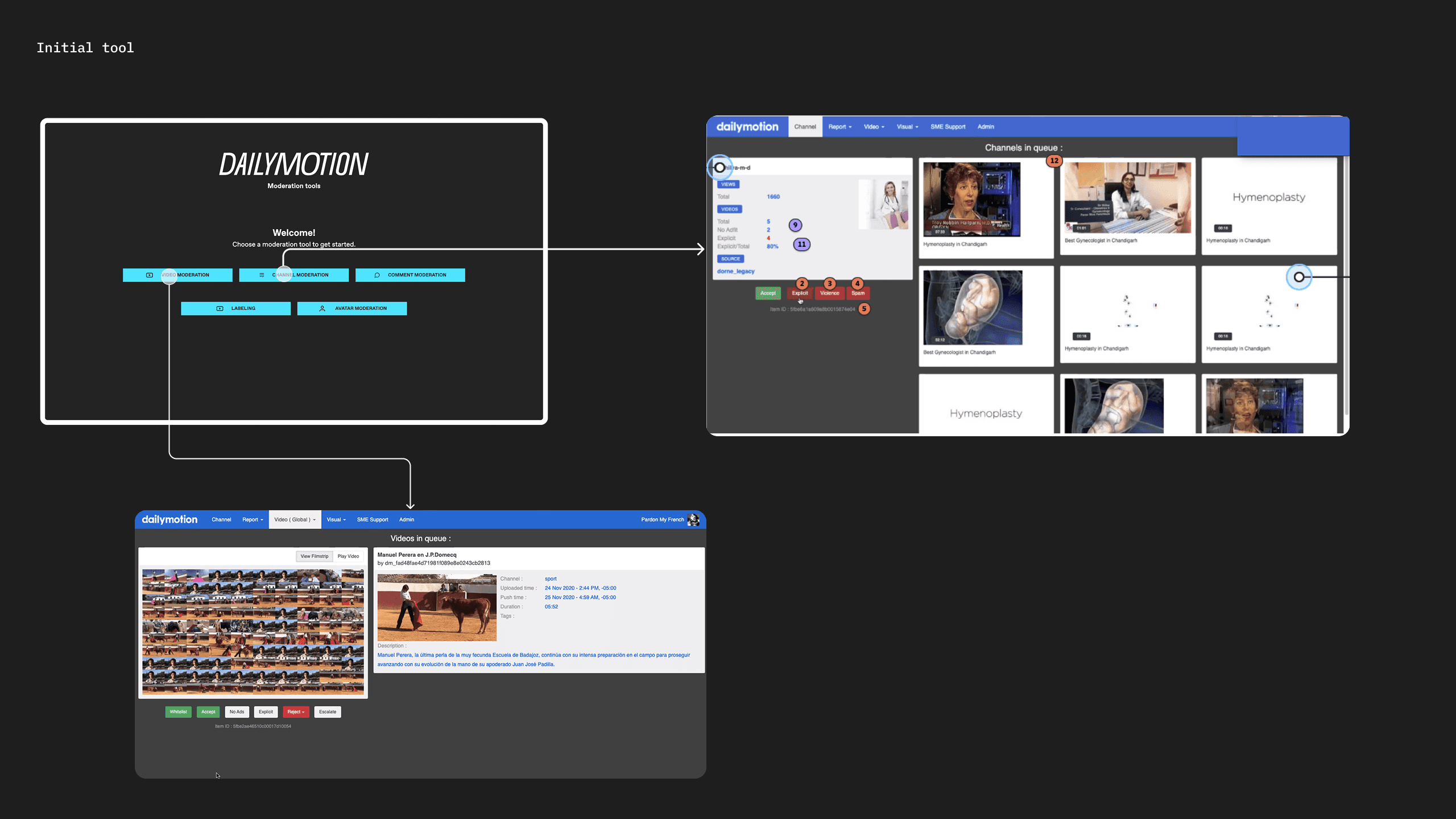
The moderation platform was used daily by professional content moderators responsible for reviewing large volumes of videos and channels. Each decision carried legal, safety, and brand implications, yet the existing tool did not support decision-making under pressure. The interface was fragmented, unintuitive, and cognitively heavy, forcing moderators to constantly switch context and rely on memory rather than structure. As a result, moderators either slowed down to avoid mistakes or rushed decisions with higher error risk. The core problem was not a lack of features, but the absence of a clear, reliable system to help humans make high-stakes decisions repeatedly, over long sessions.
The moderation platform was used daily by professional content moderators responsible for reviewing large volumes of videos and channels. Each decision carried legal, safety, and brand implications, yet the existing tool did not support decision-making under pressure. The interface was fragmented, unintuitive, and cognitively heavy, forcing moderators to constantly switch context and rely on memory rather than structure. As a result, moderators either slowed down to avoid mistakes or rushed decisions with higher error risk. The core problem was not a lack of features, but the absence of a clear, reliable system to help humans make high-stakes decisions repeatedly, over long sessions.
Challenge
The main challenge was balancing two opposing forces: increasing moderation throughput while reducing the likelihood of errors. Moderators worked long hours, in dark environments, on large screens, and were expected to maintain focus across hundreds of decisions per session. The platform also needed to support multiple moderation types (videos and channels initially, with messages and comments planned later) without fragmenting the experience. On top of this, the solution had to be scalable, adaptable to changing screen sizes, and resilient to future product evolution, all while remaining fast, safe, and mentally sustainable for its users.
The main challenge was balancing two opposing forces: increasing moderation throughput while reducing the likelihood of errors. Moderators worked long hours, in dark environments, on large screens, and were expected to maintain focus across hundreds of decisions per session. The platform also needed to support multiple moderation types (videos and channels initially, with messages and comments planned later) without fragmenting the experience. On top of this, the solution had to be scalable, adaptable to changing screen sizes, and resilient to future product evolution, all while remaining fast, safe, and mentally sustainable for its users.
Design process
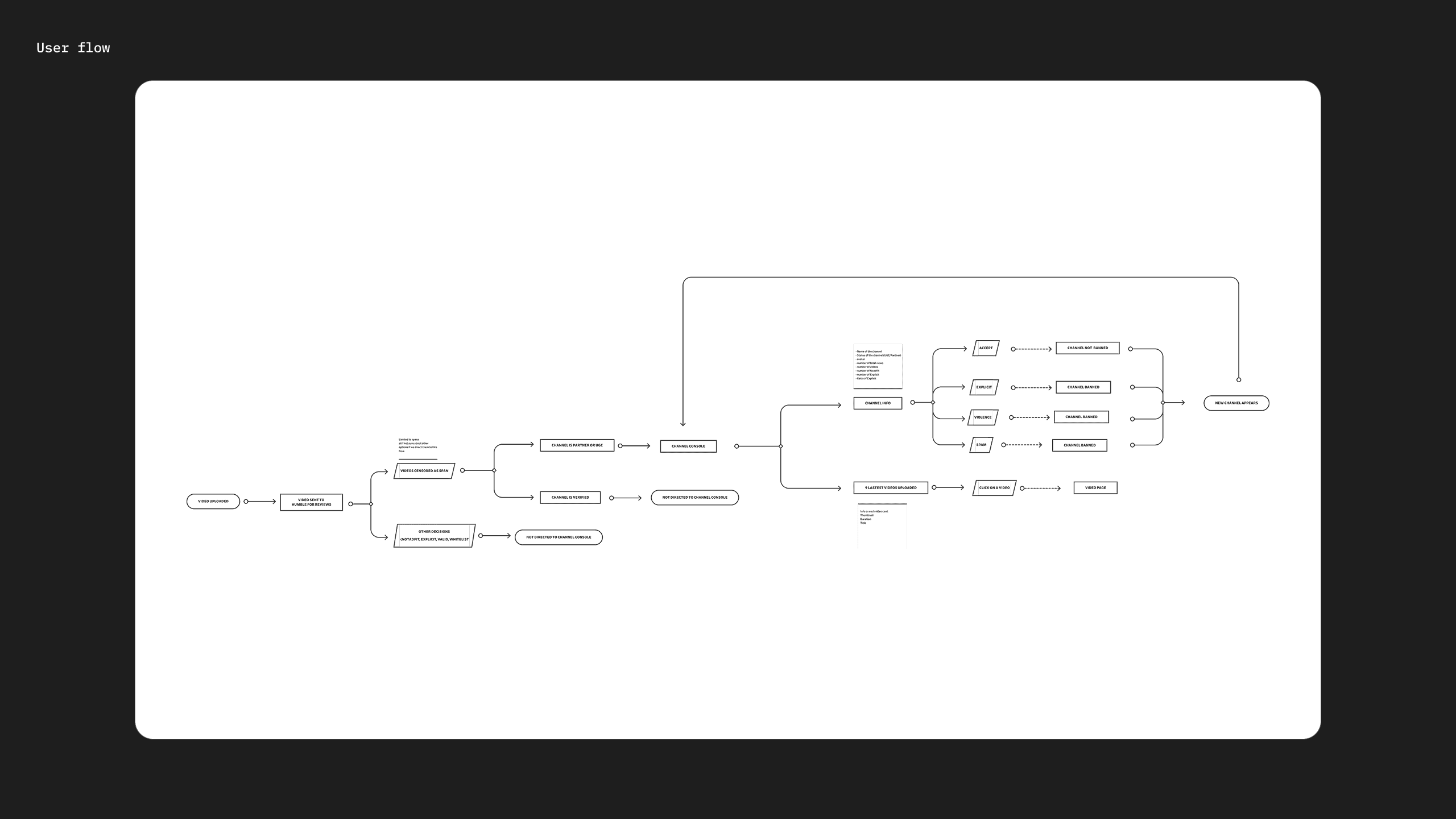
Before designing anything, I audited the existing moderation flow end to end to understand how decisions were currently made, where time was lost, and where uncertainty appeared. I conducted interviews and observational sessions with moderators to understand how they scanned information, where their eyes naturally went, which signals they trusted, and what made them hesitate before taking action. This helped identify that moderation is fundamentally a decision-quality problem rather than a speed or UI problem. Based on these insights, I mapped a unified decision flow that could apply to different moderation objects, validated early UX flows with users, and iterated closely with product managers and engineers to align on technical constraints, performance considerations, and safety guardrails before moving into final UI design.
Before designing anything, I audited the existing moderation flow end to end to understand how decisions were currently made, where time was lost, and where uncertainty appeared. I conducted interviews and observational sessions with moderators to understand how they scanned information, where their eyes naturally went, which signals they trusted, and what made them hesitate before taking action. This helped identify that moderation is fundamentally a decision-quality problem rather than a speed or UI problem. Based on these insights, I mapped a unified decision flow that could apply to different moderation objects, validated early UX flows with users, and iterated closely with product managers and engineers to align on technical constraints, performance considerations, and safety guardrails before moving into final UI design.
Solution
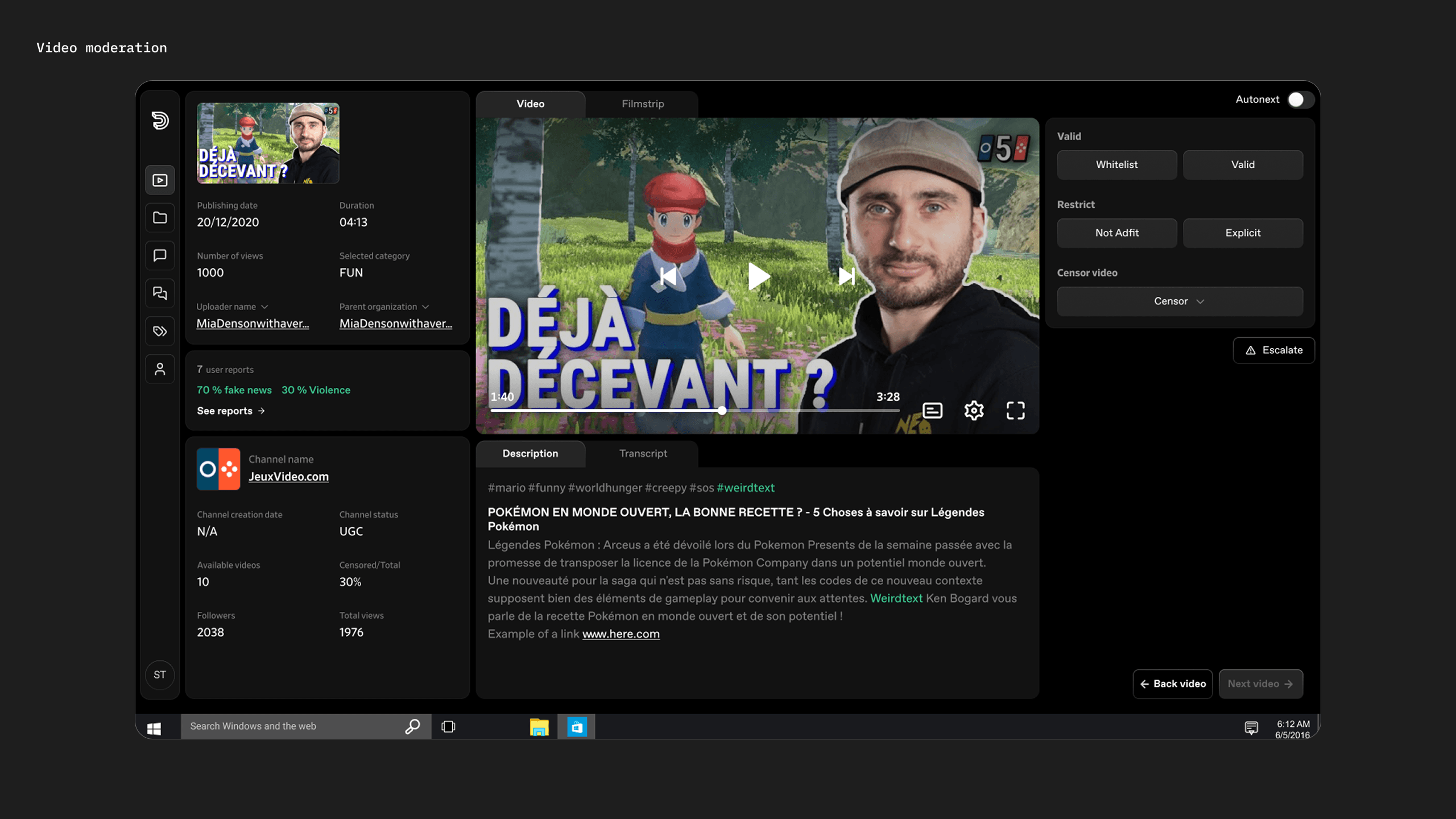
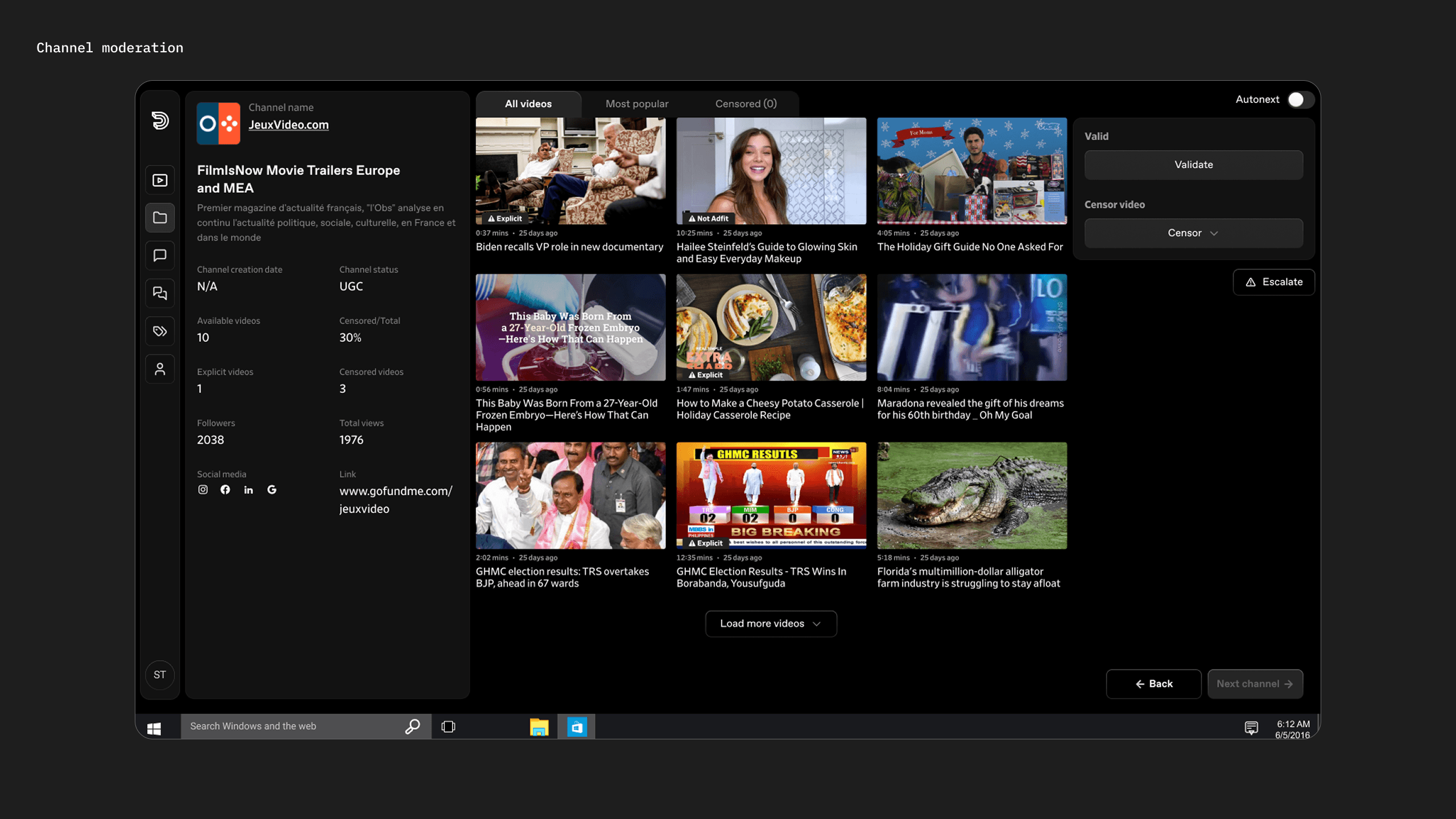
The solution was a unified moderation system structured around a stable three-part decision architecture: context, content, and action. The interface was designed in dark mode with a highly restrained black-and-white palette to reduce visual fatigue and ensure that only critical alerts attracted attention. Essential decision signals were visible by default, while deeper information was progressively disclosed to support verification when uncertainty existed. High-risk actions were intentionally slowed down through two-step confirmations, making destructive decisions more deliberate than validation. Navigation was minimized and optimized for expert muscle memory, while remaining expandable and adaptable to future moderation types and different screen sizes. The result was not just a redesign, but a shift from a content viewer to a true production decision system.
The solution was a unified moderation system structured around a stable three-part decision architecture: context, content, and action. The interface was designed in dark mode with a highly restrained black-and-white palette to reduce visual fatigue and ensure that only critical alerts attracted attention. Essential decision signals were visible by default, while deeper information was progressively disclosed to support verification when uncertainty existed. High-risk actions were intentionally slowed down through two-step confirmations, making destructive decisions more deliberate than validation. Navigation was minimized and optimized for expert muscle memory, while remaining expandable and adaptable to future moderation types and different screen sizes. The result was not just a redesign, but a shift from a content viewer to a true production decision system.
Watch recorded Prototype
Data
10
%
less errors in decision making
Learnings
This project reinforced that designing for professionals is about supporting judgment, not just optimizing speed. Intentional friction can be a feature when decisions are irreversible, and reducing cognitive load is often more impactful than adding shortcuts. I also learned the importance of designing systems that can scale across entities and time, rather than solving isolated use cases. Finally, working closely with PMs and engineers from the start proved essential to ensure that design decisions were grounded in technical reality, operational constraints, and long-term product strategy.
This project reinforced that designing for professionals is about supporting judgment, not just optimizing speed. Intentional friction can be a feature when decisions are irreversible, and reducing cognitive load is often more impactful than adding shortcuts. I also learned the importance of designing systems that can scale across entities and time, rather than solving isolated use cases. Finally, working closely with PMs and engineers from the start proved essential to ensure that design decisions were grounded in technical reality, operational constraints, and long-term product strategy.