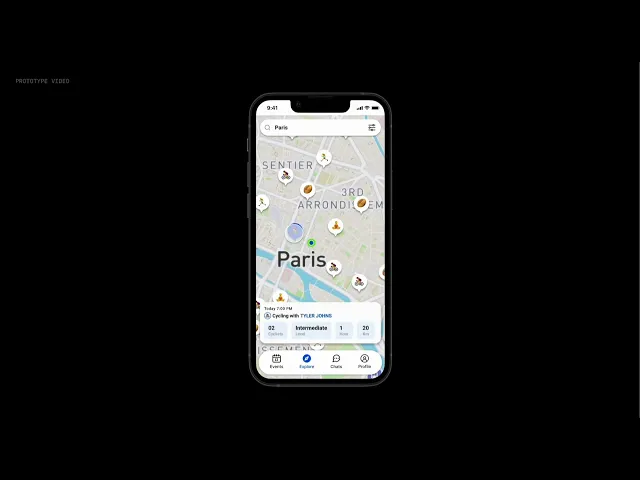
Building a start-up to connect sports lovers: Catch
Building a start-up to connect sports lovers: Catch
Building a start-up to connect sports lovers: Catch
Project:
Building a start-up to connect sports lovers: Catch
COMPANY:
Catch
ROLE:
Co-founder and CPO
SCOPE:
Product design, Product management, Consumer tech
TEAM:
Co-founder & CEO, 1 dev
Timeline:
1 year
Problem
Despite the explosion of fitness apps and social platforms, finding real, nearby workout partners remains surprisingly difficult. Existing solutions either focus on performance tracking, broad social meetups, or one-off experiences, but rarely address the specific need of spontaneously connecting with compatible people to work out together. As regular sports practitioners, my co-founder and I personally experienced this gap: motivation dropped when training alone, and existing platforms felt either too generic, unsafe, or misaligned with the realities of casual, recurring workouts. The problem was not a lack of interest in sports, but the absence of a product designed specifically around human connection in the context of physical activity.
Despite the explosion of fitness apps and social platforms, finding real, nearby workout partners remains surprisingly difficult. Existing solutions either focus on performance tracking, broad social meetups, or one-off experiences, but rarely address the specific need of spontaneously connecting with compatible people to work out together. As regular sports practitioners, my co-founder and I personally experienced this gap: motivation dropped when training alone, and existing platforms felt either too generic, unsafe, or misaligned with the realities of casual, recurring workouts. The problem was not a lack of interest in sports, but the absence of a product designed specifically around human connection in the context of physical activity.
Challenge
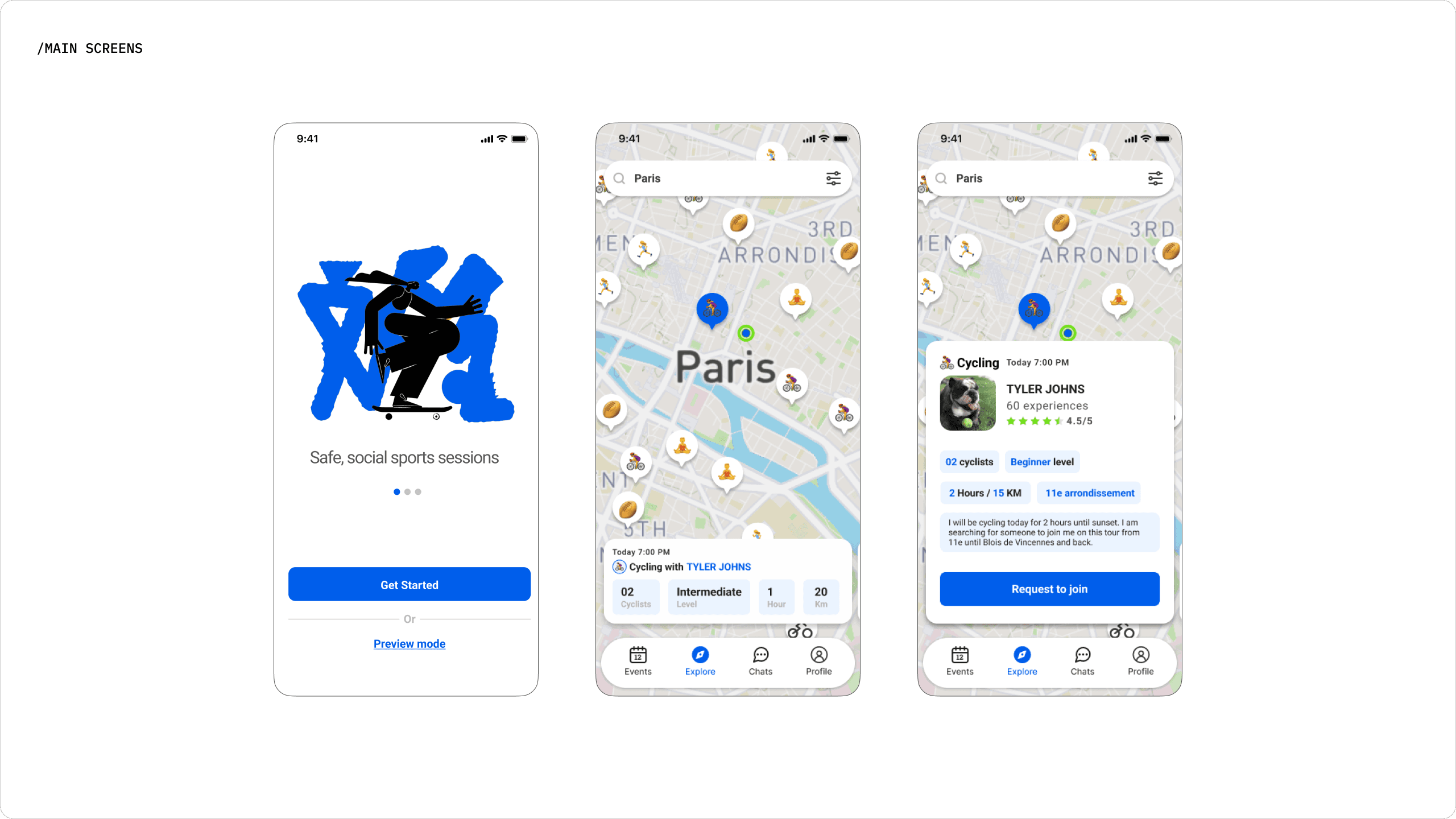
The main challenge was solving a classic consumer marketplace problem: value depends entirely on active participation. Catch needed enough users in the same locations, at the same time, with overlapping interests, to create meaningful matches. This made user acquisition and early liquidity extremely difficult. In addition, the product had to balance strong safety guarantees, inclusivity, and personalization without introducing friction that would further slow adoption. Designing for trust, discovery, and coordination simultaneously—while competing with well-established platforms like Meetup or Strava—required difficult trade-offs between focus, simplicity, and growth speed.
The main challenge was solving a classic consumer marketplace problem: value depends entirely on active participation. Catch needed enough users in the same locations, at the same time, with overlapping interests, to create meaningful matches. This made user acquisition and early liquidity extremely difficult. In addition, the product had to balance strong safety guarantees, inclusivity, and personalization without introducing friction that would further slow adoption. Designing for trust, discovery, and coordination simultaneously—while competing with well-established platforms like Meetup or Strava—required difficult trade-offs between focus, simplicity, and growth speed.
Design process
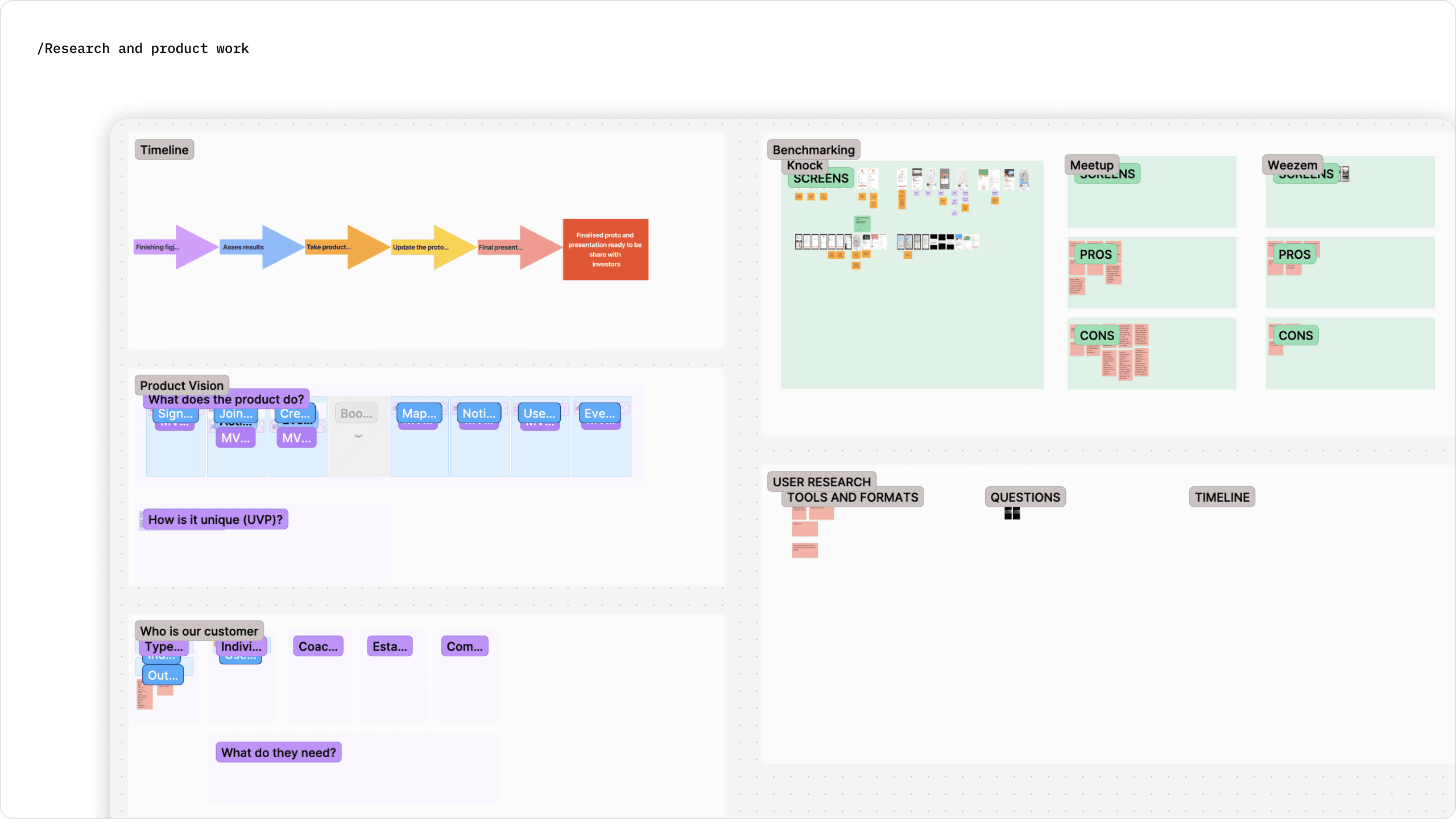
We began by validating the concept through user research with fitness enthusiasts, coaches, and casual practitioners to understand how they currently organize workouts, what prevents them from joining group activities, and what safety concerns block adoption. I designed an end-to-end prototype in Figma to quickly test flows such as onboarding, activity creation, partner matching, and discovery. The prototype was used both for user testing and to communicate the product vision to potential engineers and stakeholders. We iterated based on feedback, particularly around safety features, personalization controls, and clarity of value during first use, while continuously reassessing which features were essential for an MVP versus what could wait.
We began by validating the concept through user research with fitness enthusiasts, coaches, and casual practitioners to understand how they currently organize workouts, what prevents them from joining group activities, and what safety concerns block adoption. I designed an end-to-end prototype in Figma to quickly test flows such as onboarding, activity creation, partner matching, and discovery. The prototype was used both for user testing and to communicate the product vision to potential engineers and stakeholders. We iterated based on feedback, particularly around safety features, personalization controls, and clarity of value during first use, while continuously reassessing which features were essential for an MVP versus what could wait.
Solution
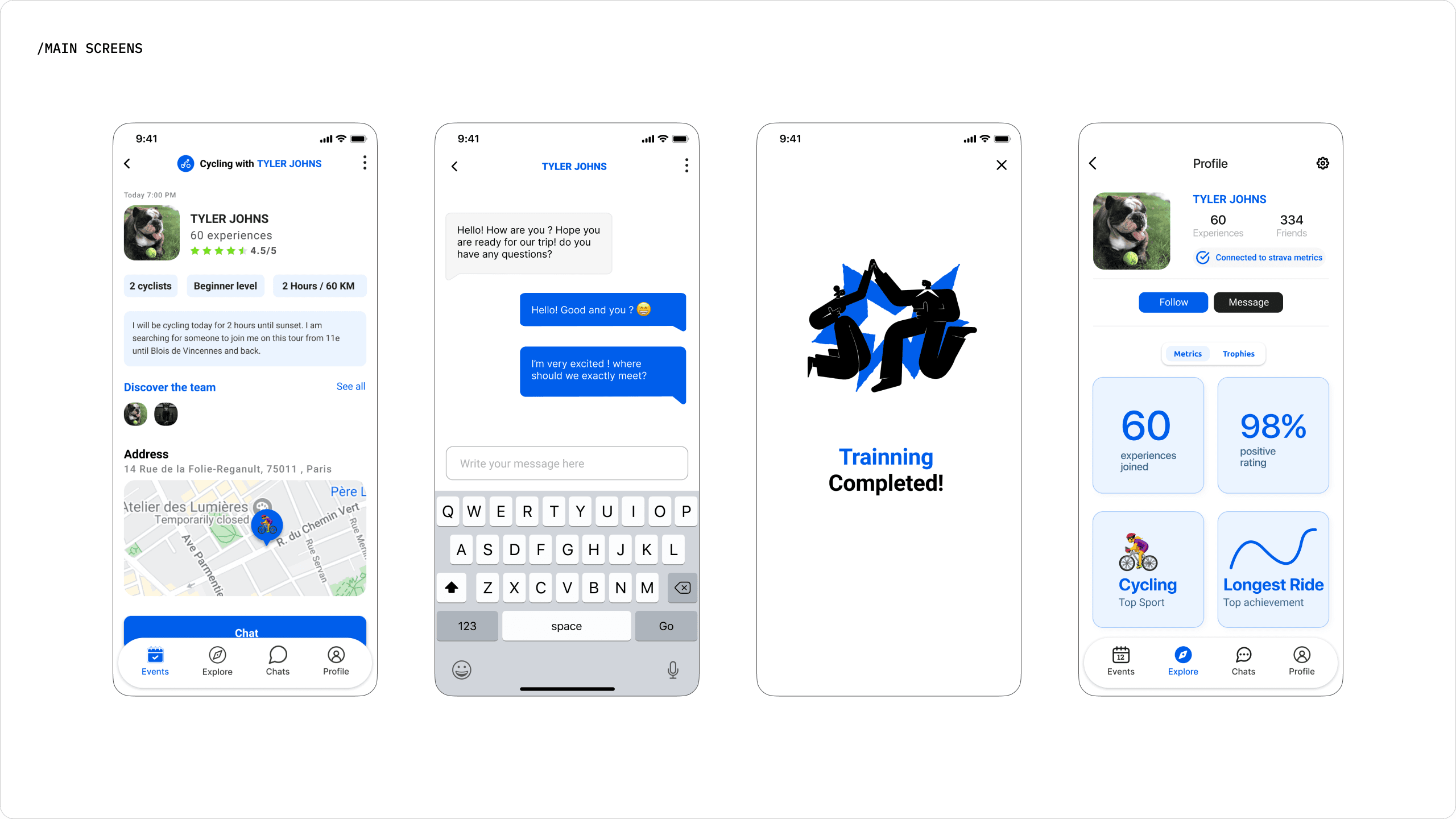
The resulting MVP positioned Catch as a dedicated platform for connecting workout partners and communities, built around three core pillars: safety, personalization, and quality of experience. Users could define their preferred activities, skill level, and group size, discover nearby workouts, and join or organize sessions with confidence. Safety was embedded through user verification, activity visibility, and feedback mechanisms, while discovery was optimized to surface relevant people and events quickly. The experience was intentionally designed to feel lightweight and inclusive, lowering the barrier to participation while encouraging real-world interaction rather than prolonged in-app engagement.
The resulting MVP positioned Catch as a dedicated platform for connecting workout partners and communities, built around three core pillars: safety, personalization, and quality of experience. Users could define their preferred activities, skill level, and group size, discover nearby workouts, and join or organize sessions with confidence. Safety was embedded through user verification, activity visibility, and feedback mechanisms, while discovery was optimized to surface relevant people and events quickly. The experience was intentionally designed to feel lightweight and inclusive, lowering the barrier to participation while encouraging real-world interaction rather than prolonged in-app engagement.
Learnings
This project was a valuable lesson in marketplace dynamics and the difference between a strong user need and a scalable product. I learned that even well-designed, well-intentioned experiences can fail without a clear acquisition strategy and early liquidity. Designing for trust and safety is essential, but must be balanced carefully against friction in onboarding and growth. As both designer and product manager, the experience sharpened my understanding of MVP scoping, go-to-market dependencies, and the importance of validating distribution channels as early as the product itself. Catch reinforced that product success is as much about timing, density, and strategy as it is about design quality.
This project was a valuable lesson in marketplace dynamics and the difference between a strong user need and a scalable product. I learned that even well-designed, well-intentioned experiences can fail without a clear acquisition strategy and early liquidity. Designing for trust and safety is essential, but must be balanced carefully against friction in onboarding and growth. As both designer and product manager, the experience sharpened my understanding of MVP scoping, go-to-market dependencies, and the importance of validating distribution channels as early as the product itself. Catch reinforced that product success is as much about timing, density, and strategy as it is about design quality.